
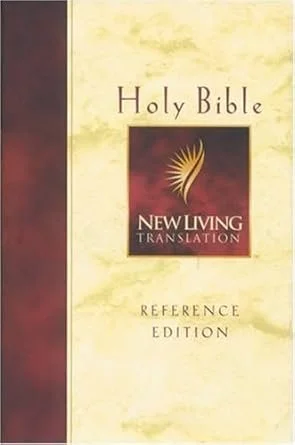
New Living TranslatiON
Each year I read the Bible using a different version. Last year I worked through the very accurate, but stiff, American Standard Version. This year, I am going back to the New Living Translation. Last year, i used my Kindle. This year, I want to go back to paper.
It is nice to hold this sturdy (simulated) leather-bound version in my hand, to literally turn the pages, feeling my way to familiar passages, and to mark it up (I'm an unapologetic marker of my books).
I don't know if most folks read the introductions to their Bibles (I suspect not). I do. I am particularly interested in the transition philosophy of the translation team. Here’s what the CSB translation editors have noted:
Most discussions of Bible translations speak of two opposite approaches: formal equivalence and dynamic equivalence. This terminology is meaningful, but Bible translations cannot be neatly sorted into these two categories. There is room for another category of translation philosophy that capitalizes on the strengths of the other two. (p. v)
That third philosophy is the "Optimal Equivalence" approach.
Translation Philosophies:
Formal Equivalence: Broadly speaking, "formal equivalence" seeks to preserve the structure of the original manuscripts, favoring what some refer to as a "word-for-word equivalence, even though syntactically such an approach may make the rendering harder to understand.
Dynamic Equivalence: A "dynamic" or "functional equivalence" approach favors placing emphasis on clarity and readability by "extracting the meaning of a text from its form and then translating the meaning so that it makes the same impact on modern readers that the ancient text made on its original readers" (p. vi). "
Optimal Equivalence: "approaches translation in way that seeks to preserve both the words and thoughts of the original manuscripts. . . . When a word-for-word rendering is understandable, a literal translation is used. When a word-for-word rendering might obscure the meaning for a modern audience, a more dynamic translation is used" (p. vii).
THE NLT takes the …
Lasting Impact:
God's Word revises the soul (Psalm 19:7), gives direction to one's path (Psalm 119:105), and shows the way to salvation (1 John 5:11-12). It points me to the One about whom the entire arc of God's Word points -- Jesus, the One who is making all things new (Revelation 21:5) and who reminds me, "I am coming soon" (Revelation 22:7,12,20). So with John the Apostle, I say, "Even so, come Lord Jesus" (Revelation 22:20), and with the David, "My soul bless the LORD!" (Psalm 103:22) and with that resounding crescendo of the Psalter: "Let everything that breathes praise the LORD. Hallelujah!" (Psalm 150:6). And with Jesus, I affirm: "Your word is truth!" (John 17:17)
My recommendation: God's Word does not need my recommendation.
