
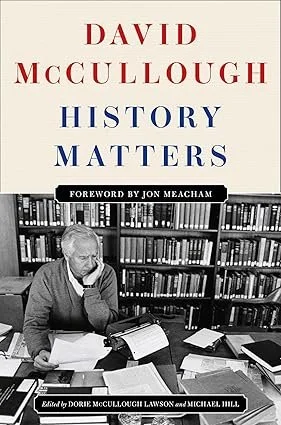
by David McCullough
DON’T READ History Matters, by David McCullough. STUDY IT!
My deepest thanks to Dorie McCullough Lawson and Michael Hill for their efforts to bring this book to life; the former, the daughter of the famed historian and the latter, his researcher of thirty years.
A collection of essays, speeches, reflections; some previously published and some not, History Matters could be titled “writing matters” or “reading matters” or “taking your time matters” or “mastering your craft matters.” Why? Because these pages take us into McCullough’s writing room —his backyard office— on Martha’s Vineyard, “just eight feet by twelve,” but more than that they allow us to wander around in his heart and soul.
We hear in his own words (and you will hear some of his own words in the Audible version, making it a worthwhile companion to the printed page) the authors and experiences that shaped him. We also discover why some individuals would occupy so much of his life (John Adams, 6 years; Harry Truman, 10 years), while others (Picasso comes to mind) would be passed by after an initial start.
ABOUT David McCullough & History matters
David McCullough (1933-2022) twice received the Pulitzer Prize, for Truman and John Adams, and twice received the National Book Award, for The Path Between the Seas and Mornings on Horseback. He was the recipient of numerous honors and awards, including the Presidential Medal of Freedom, the nation’s highest civilian award.
This book “is by no means exhaustive, and there are certainly areas of his work, his life, and his personality that are not covered, including among other things, his disciplined way of approaching everything, his love of walking and walking sticks, his insistence on things being done in particular ways, his love of lyrics and quotations, and his readily available humor. But above all, what is not sufficiently represented here is Rosalee. There is not enough of Rosalee . . . Rosalee Barnes McCullough, his wife of nearly sixty-eight years and mother of his five children. She was his true north, and it was she who truly made it all possible” (x).
His discipline: McCullough wrote 4 pages a day.
His typewriter: A 1940s Royal manual typewriter he bought in 1965 and on which he typed his first book, The Johnstown Flood, and every other book he wrote. Incidentally, my son and I heard him share this story at a lecture he gave at Florida Atlantic University.
About his writing: “David McCullough painted with words.” John Meacham
Why History?
History shows us how to behave. History teaches and reinforces what we believe in, what we stand for, and what we ought to be willing to stand up for. History is—or should be—the bedrock of patriotism, not the chest-pounding kind of patriotism but the real thing, love of country. At their core, the lessons of history are largely lessons in appreciation (3).
McCullough loved quotes. Here are some:
“Any nation that expects to be ignorant and free, expects what never was and never will be,” Thomas Jefferson (4).
“A few hours’ intelligent study is better than a whole day of thoughtless plodding,” American artist Thomas Eakins (51-57).
“Affliction is a good man’s shining time,” Abigail Adams quoting the poet Edward Young, in reference to George Washington.
“It is not in mortals to command success, but we’ll do more, we’ll deserve it,” Quoted in Washington’s and Adam’s letters; it comes from Joseph Addison’s play Cato (75).
True courage: Truman once said, it takes one kind of courage to face a duelist, but it’s nothing like the courage it takes to tell a friend no (80).
“The object and its accomplishment is my philosophy,” Harry S. Truman (90).
On Ezra Stiles: Even in the last years of his life, Stiles (one of the most learned men in America) “still kept his omnivorous curiosity” always “more interested in what he did not know than what he did,” Professor Edmund Morgan (102).
John Adams on liberty: “Liberty cannot be preserved without general knowledge among the people who have the right to that knowledge and the desire to know. But besides this, they have a right, an indisputable, unalienable, indefeasible, divine right to that most dreaded and envied kind of knowledge — I mean of the character and conduct of their rulers” (96).
Books he urges you to read:
My Amazon cart subtotal has been climbing as I read this book. I keep adding McCullough recommendations, of which there are many, and he ALWAYS gives you the WHY behind his urging. Here are a few (you’ll have to read the book for the why). Those below represent a fraction of his recommends:
“If you’ve never read I Ricordi by Guicciardini, I urge you to do so” (13).
“Saint-Exuperys Wind, Sand and Stars is one of the greatest books that deal with the problem in nature” (15).
Writers at Work: The Paris Review Series (vii, 133).
Great River by Paul Horgan (122).
Moon Tiger by Penelope Lively (100).
Silas Marner: A poignant narrative of hardship, compassion, and the enduring hope found in humanity by George Elliot
A Political Education by Harry McPherson (160).
The Education of Henry Adams, by Henry Adams (161).
The Guns of August, by Barbara Tuchman (160).
Gay Place, Being Three Related Novels: The Flea Circus, Room Enough to Caper, Country Pleasures, by Billy Lee Brammer (159).
McCullough on Writing:
“Look at your fish,” Louis Agassiz (27).
The motto that is tacked over his desk. “Seeing is as much the job of a historian as it is of a poet or a painter, it seems to me. That’s Dickens’ great admonition to all writers, ‘Make me see’” (27-28).“Four pages a day.” McCullough wrote about his encounter with Harry Drago, who wrote over 100 books.
“Mr. Drago,” I said. “Alvin Josephy says that you’ve written over a hundred books.” “Yes,” he said, “That’s right.” “How do you do that?” I asked. And he said, “Four pages a day.” “Every Day?” “Every day.” It was the best advice an aspiring writer could be given (31-32).Working in the book. When people ask, “Are you working on a book?” he tells them they’ve got the wrong preposition. “I’m in the book, in the subject, in the time and the place” (33).
On why he doesn’t use a computer: People say, “But with a computer you could go so much faster.” But I don’t want to go faster. If anything, I should go slower. I don’t think all that fast. (there’s more on page 38. You’ve got to read it).
Keep your hero in trouble (in the context of why he didn’t write a biography on Picasso). “There’s an old writer’s adage: keep your hero in trouble. With Truman, for instance, that’s never a problem, because he’s always in trouble. Picasso, on the other hand . . . lived a prosaic life. McCullough added, you don’t have to love your subject, but Picasso was an awful man. “Why subject yourself to someone you have no respect for, or outright don’t like?” (44).
Makes use of four talents: “A writer must see with the painter’s eye; a writer must have an ear for the music of words; a writer must have the actor’s gift for mimicry, the capacity to take any part” (125, 133).
Write to make music. “An an old piano teacher liked to say to her students, ‘I hear all the notes, but I hear no music.’ Write to make music. Don’t just pound out notes. We are all trying to make music. There is no one way to write. It’s what works for you. Very often, you won’t know what works for you until you’ve done those four pages a day maybe for four or five years. It’s when you begin writing that you begin to see how much more you need to know” (145-146).
Rewrite, rewrite, and rewrite. “When asked if I’m a writer, I think sometimes I should say, ‘No, I’m a rewriter’” (148). Write for the ear as well as the eye. Put what you’ve written on the shelf for a while and then read it again.
A series of decisions: "Every day, writing a book is a series of decisions—what to leave out, how to simplify, how to clarify, how to be clear. That’s hard. That’s what writing is—it’s thinking. And to write well is to think clearly, which is why it’s so hard (160).
Other lessons learned:
Time is limited. You can’t do everything.
”I thought about writing a new foreword to the twenty-fifth anniversary printing, but there are a lot of things I’d like to do that I don’t have time for” (41).
Doing things well.
The hardest thing with writing is to make it look effortless. It’s true of everything that’s done well. People see a performer or an artist or a carpenter and they think, Well, that looks easy. Little do they know (45).
Leaders must be inside and outside of an event at the same time.
This is an admonition I frequently share with leaders. When discussing George Washington, for whom McCullough has the deepest regard, he references the character Emily in Thornton Wilder’s Our Town. Emily says at the end of the play that the hardest thing in life is to realize it while it’s happening to you. McCullough comments: “And that’s very true of history. We assume that everybody who’s involved in historic events is caught up in the fact that they are involved in an historic event.” His point: They are not. My takeaway was the line delivered by Emily as it relates to life in general.
On George Washington as a leader.
But most of all, he was a leader. I think that's the essence of George Washington. He was a leader, and he could inspire people to do things beyond what they thought they had the capacity to do.... he knew how to lead men, and after the war, he knew how to lead the country.
McCullough viewed Abigail Adams as one of the most astute observers of that era. About Washington she said, “he is polite with dignity, affable without familiarity, distant without haughtiness, grave without austerity, modest, wise, and good” (72).
Why George Washington was “the greatest man in the world.”
He was the real thing... He was the authentic thing... This man who wouldn't give up, who wouldn't give in, wouldn't give up no matter what, gives up the most important thing of all--power. It's portrayed in the painting in the Rotunda. He's turning over the command, the power of the continental army, to the Congress after the war period no concrete general had ever done that. And when George the third heard this was going to happen, he said, “if he does that, he will be the greatest man in the world” and he did, and he was (76).
On Harry Truman:
Truman shows the importance of character in the life of the president. “He showed again and again that he understood the office, how the government works, and that he understood himself. He knew who he was, he liked who he was. He liked Harry Truman. He enjoyed being Harry Truman. He was grounded, as is said. He stressed, “I tried never to forget who I was, where I came from, and where I would go back to” (78).
Recommendation:
Hopefully, reading this review you can see why I wrote, “Don’t read History Matters, study it!” This book is a collection and it is the collection that gives us a better appreciation of McCullough as it also instructs and points us to things that matter. History Matters is background stories on Franklin Roosevelt’s rabbits foot (18) or Wilbur Wright’s hockey accident (19-20). It is McCullough’s love of books, of history and the people who populate it; it is painting with words, great quotes, fascinating anecdotes, an introduction to writers I never have read but now will. It is seeing a man at his craft, loving his craft, excelling at his craft . . . and bringing insight, life learning, and joy from the tap, tap, tap on an old Royal typewriter. It is seeing work cease to be “work.”
In his essay, “The Good Work of America,” McCullough writes, “Work got us where we are. Easy does it has never done it for us and never will. We are the beneficiaries of men and women who toiled ten, twelve hours a day on farms, on railroads, in mines, in mills, at kitchen sinks and drafting tables.” And we might add, “in eight by twelve foot offices on Martha’s Vineyard so that reading this man’s work we may better appreciate that work and be inspired to contribute to it by our efforts.
