
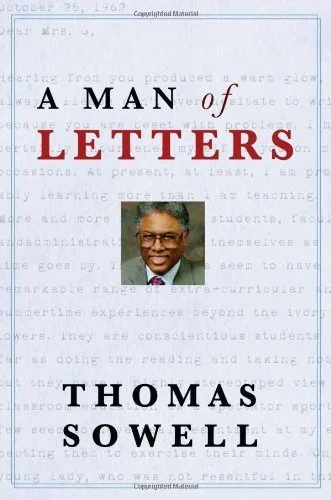
by Thomas Sowell
Recently, a friend asked, “If you could have a conversation with three friends and any three people of history, who would you choose? Thomas Sowell was in that inner circle for me. Brilliant intellect. Careful thinker. Not swayed by popular opinions or political correctness, Sowell has written extensively on race, culture, economics, and social policy.
“Thomas Sowell is a whack on the side of the head with the strong hand of common sense and careful thought.”
About A Man Of Letters
In A Man of Letters, Sowell shares from his abundant correspondence over his long and storied career. While not an autobiography, the book takes us on chronological journey in which this “man of letters” gives us insights into his life at each of these correspondence junctures. Mona Charen of the Hoover Institute wrote this about the book:
This may be the most unlikely tale of a high school dropout you will ever read—and the most satisfying. Thomas Sowell (he went back to school after testing the market’s receptivity to a skill-free youth of 16) is a highly organized person who kept copies of all of his letters even before the days of e-mail and computers. We are the richer for it. In his new book, A Man of Letters (Encounter Books), Sowell has mined his files to offer us keen insights into our nation’s recent history and into the soul of an extraordinary man.
Sowell’s letters carry the kind of weight one would find in the correspondence between John and Abigail Adams or that of Adams and Jefferson in the latter years. For an individual to “write” a book that pertains to the letters he has written or received over the course of his lifetime, speaks to the volume of correspondence and length of life, not to mention the interest level necessary to engage a reader.
Jim Michaels, Editor Emeritus, Forbes Magazine, calls A Man of Letters “a sampling and a peek of the man behind [the] devastation of Political Correctness.”
Who is Thomas Sowell
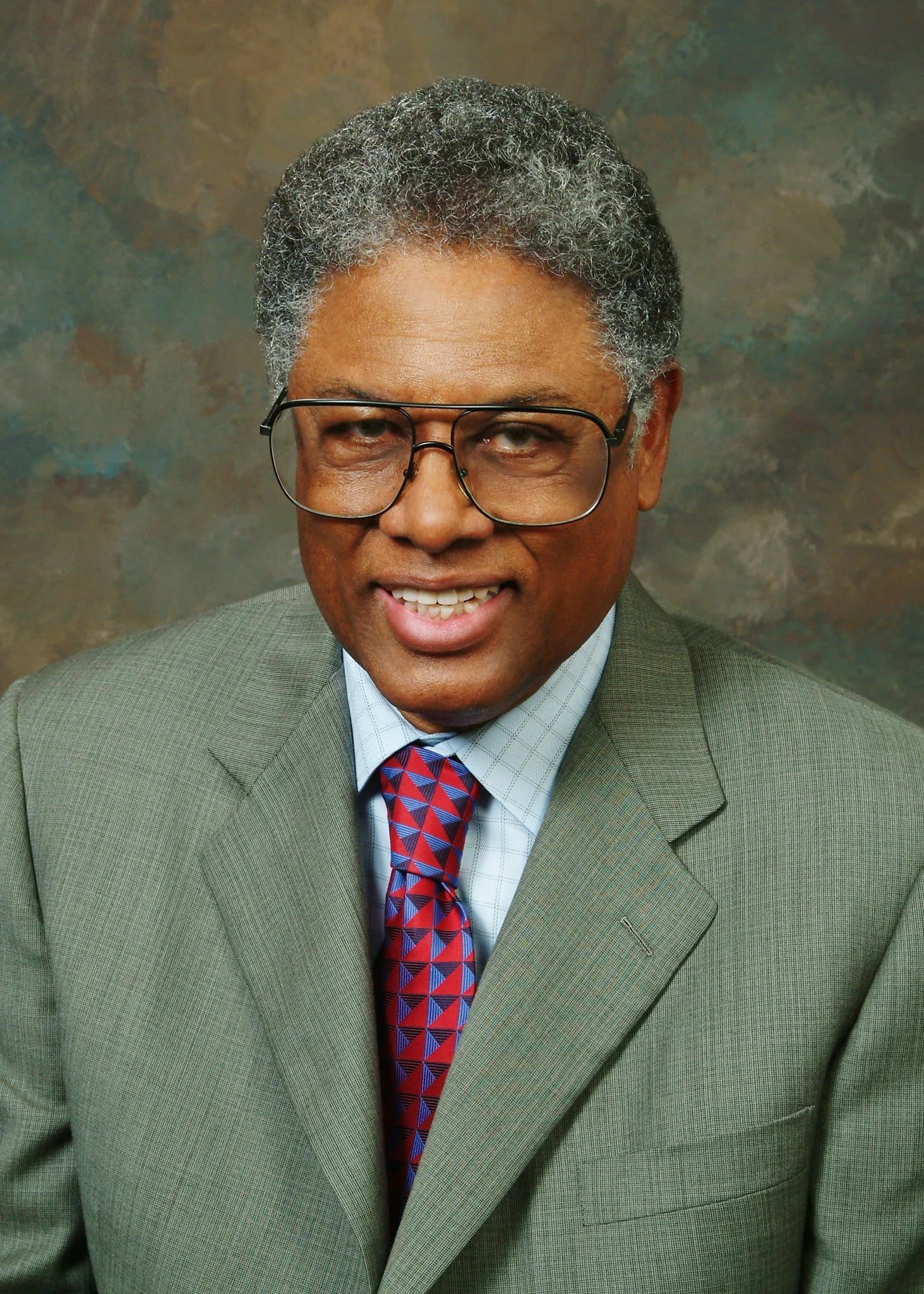
Born: June 30, 1930 (age 95 as of this writing).
Position: The Rose and Milton Friedman Senior Fellow on Public Policy, Emeritus, at the Hoover Institution. Read here for the Hoover Institute bio.
Expertise: Sowell writes on economics, history, social policy, ethnicity, and the history of ideas. See his About Page at the Hoover Institute.
Interesting fact: First black male to teach at Douglass College, the predominantly white women’s college, now a part of Rutgers University.
Education: Harvard (BA), Columbia University (MA), University of Chicago (PhD)
To relax: Bowling and photography. Sowell often turned to bowling as a release from stress and his bowling scores could reflect his state of stress or anxiety: “One index of my relief was that I went directly to the bowling alley and bowled my highest score in years (268)!” (94).
Marital status: Married Alma Parr (1964, divorced 1975); Married Mary Ash (1981), “my dear friend Mary, whom I had first met during my year at the Center for Advanced Study in 1976.”
About photography: I was sent to the photography School at the Naval Air station in Pensacola, Florida. It was not only the best assignment during my military service, it gave me a marketable skill and a greater ability to enjoy photography--and photography remained a major interest for the rest of my life (viii).
Major influence in his life: Mrs. Gadsden, who taught him freshman English at Howard University. He kept up a life-long correspondence with her.
On recognizing one’s limitations: “The problem is not so much time as it is having other people expecting me to do things and carrying the weight of those expectations. Therefore, I am clearing my calendar. If and when I write anything suitable for the press, I shall have at that time considered the question of a suitable outlet for it." Letter to Meg Greenfield at the Post.
Summary: Sowell has taught and written extensively and is considered by many America’s greatest living economist.
About this Review:
My reviews tend, at times, to be interminably long. This is no exception so apologies in advance. If you want the quick review, here it is: Buy the book if you want to read the letters of one of America’s greatest thinkers. Otherwise, I have divided my work by subjects to enable you to skip here and there as interests you. For his part, Dr. Sowell, divided his book by decades, beginning with his correspondence in the 60s and ending with the 2000s.
Sowell on Hard Work
Thomas Sowell was a high school dropout who became a leading intellectual. I start with hard work, because it is essential to understanding him. He was the son of a sharecropper and raised poor in Harlem. The first of his family to graduate college, Sowell was blessed with people in his formative years that did not coddle him or make excuses for him. While most of the references are made in conjunction with culture and social class, in reading them one can see the bigger issue for Sowell was personal responsibility. These are great words for any young person or parent of one.
On black youth unemployment
Some people argue that the answer to black youth unemployment is either a general “full employment” policy or specific job creation programs targeted for that group…. This seems far less likely to be due to “skills,” as ordinarily conceived, than to acquiring the necessary work habits--the discipline of a schedule, the ability to work with others, and the general shedding of immaturity. As one who was once part of those black teenage unemployment statistics--thank God, in the 1940s when it wasn't so bad--I know how painful the adjustment can be for both young workers and for the employer.... What worries me about job creation is that the jobs created will be watered down in their on-the-job requirements and therefore unduly prolong the transition to maturity. Letter to Senator Proxmire, 3/13/78 (149-150).
About economicS and attitude in Harlem
Dr. Sowell received this letter in 1987 after Forbes magazine profiled him as someone who came out of Harlem and went on to a distinguished career. Sowell included it in this book to emphasize the fact that despite there being greater racial discrimination in those days, he and his cohort were better equipped in terms of attitudes to overcome such barriers. They were not encouraged to lean on excuses, paranoia, dependency etc.:
“Dear Dr. Sowell: I grew up at 143rd and Amsterdam, not far from your neighborhood and lived in a 5-story walk up tenement…. From just that one building came a college president, an M.D., two engineers, a lawyer, a college professor, a high school teacher and a Jesuit priest. From our viewpoint you do not attack economic orthodoxy, you express its reality” (227).
On Playing the Angles:
In a 1999 letter to a younger relative who asked about mentioning Sowell’s name when applying for a job at Forbes, Sowell said: “It would be a bad idea…. If there is any advice I would offer you, not only for this situation but for life, it would be this: DON’T PLAY THE ANGLES. Playing angles may get you some little things here and there--but at the cost of big things overall. Most people who are influential enough for you to want to influence them are usually old enough that they have seen angles being played longer than you have been in the world” (289-290).
On Disadvantages:
In a 1999 letter that addressed the so-called “disadvantages" of some: “I have suggested that rich people who feel guilty should see a psychiatrist at their own expense, rather than make public policy at other people's expense. Thank heaven I grew up in a more hard-hearted time, when my teachers in Harlem did not consider it ‘unfair’ to expect me to learn what kids in affluent neighborhoods were learning. If they had the present mushy thinking and pandered to my ‘disadvantages,’ where would I be today? Uneducated and undisciplined, I might well have ended up in some halfway house somewhere--if I were lucky. But the ‘humanitarians’ would have felt good about themselves” (292-93).
An influential poem:
Paul Laurence Dunbar’s poem (Dunbar High School) was written in 1916 and put on the walls of the segregated black school in a Jim Crow city. Most graduates from Dunbar went to college and many entered Harvard simply on the strength of having attending Dunbar High School.
Keep a-pluggin’ away
Perseverance still is king.
Time its sure reward will bring.
Work and wait unwearying.
Keep a-plugging away.
Keep a-pluggin’ away.
From the greatest to the least.
None are from the rule released,
Be thou toiler, poet, priest.
Keep a-pluggin’ away.
Again, Sowell’s themes of hard work in the face of difficulties underlies much of his thinking.
Sowell on Race & Civil rights
Sowell has written much about race, civil rights, discrimination, affirmative action (see my review of Discrimination and Disparities). One can begin to understand his perspective by examining his website’s “Favorite Quotations” page, which includes this piece from Frederick Douglass:
His general thought regarding “uplifting the blacks” can be seen in one of his favorite quotes:
Everybody has asked the question… “What shall we do with the Negro?” I have had but one answer from the beginning. Do nothing with us! Your doing with us has already played the mischief with us. Do nothing with us! If the apples will not remain on the tree of their own strength, if they are worm eaten at the core, if they are early ripe and disposed to fall, let them fall! I am not for tying or fastening them on the tree in any way, except by nature’s plan, and if they will not stay there, let them fall. And if the Negro cannot stand on his own legs, let him fall also. All I ask is, give him a chance to stand on his own legs! Let him alone!
—Frederick Douglass (Frederick Douglass, “What the Black Man Wants,” Negro Social and Political Thought 1850–1920: Representative Texts, edited by Howard Brotz (New York: Basic Books, Inc. 1962), (283).
Here are a few excerpts from his letters:
His skepticism regarding integration in the early 60s:
“There seemed to be so many other things with greater priority than equality-of-public-accommodation that the blind preoccupation with this one thing seems almost pathological. When one considers the apathy in the negroe community towards such things as the hopeless incompetence and irresponsibility of their own colleges and other institutions, the fervor generated it in the fight for “integration” in all things at all costs seems more an emotional release than a sensible movement towards something that promises it worthwhile benefit” (20-21).His disdain for special treatment for blacks:
Writing in response to a former student about the inadequacies of Howard University (where he spent his Freshman year before transferring to Harvard): “It is so easy to play fairy godmother and so heartbreakingly difficult to get people to make the painful adjustments in themselves which are necessary for any permanent improvement. Let us face it--most people are pretty damned satisfied with themselves the way they are, though they would like to see lots of improvements in the world around them” 3/19/63 (37).About the numerical underrepresentation of Negroes in certain jobs (10/6/63): Sowell argued against the reasoning behind the job quota system, that numerical underrepresentation of Negroes and certain jobs as evidence of discrimination. “Has Mr. Young ever checked the numerical representation of Negroes in free evening high schools and colleges, in public libraries and at free public concerts? (39).
The biggest single obstacle to racial progress:
”To me the psychology of the negro is the biggest single obstacle to racial progress. It isn't fashionable to say this, and it certainly isn't pleasant, but truth does not depend on these considerations. With all due respect to the courage and dedication of the various civil rights groups, I think that when all the laws have been passed and all the gates flung open, the net result will be one tremendous anticlimax unless there is a drastic change of attitude among Negroes. The current pleas for preferential treatment are a symptom of the attitude that needs changing in such treatment would be a big obstacle to the necessary change. Letter to Mary, January 4, 1964 (41-42).Letter to a black mayor in Alabama:
A black mayor in Alabama recommended relaxing the minimum wage law for teenagers. Sowell’s response: “One of the most heartening actions by black leaders in many years was your support for relaxation of the minimum wage law for teenagers.... not only do many young blacks need to be bringing in some money to low-income households; They need the work experience even more than they need the money. There's no way to move up the ladder without first getting on the ladder--and for almost everybody, that usually means getting on at the bottom. My own work experience as a teenager was enormously valuable for me to me, not only then but now. At the time I thought my boss was terribly harsh in his criticism of my work and work habits period now, decades later, I wonder how the man found the patience to put up with my incompetence. There is no way he could have paid me the minimum wage and broken even on the deal” 3/27/84 (204-5).
Affirmative Action and more:
On Preferences and Quotas (e.g. Affirmative Action)
1986, In a letter to Asst Attorney General William Bradford Reynolds, after visiting Washington D.C. to encourage the Reagan administration to rescind the Executive Orders from Presidents Johnson and Nixon which had created Affirmative Action:
“There is no way to produce anything resembling an even distribution of groups in employment, housing, or anyone else, except by suppressing the rights of ordinary people to make their own decisions and transferring that power to third parties. People do not distribute themselves evenly anywhere.... Nevertheless, the dogma prevails that non-random patterns must be due to institutional decisions. Once that crucial assumption is accepted, it is vain to resist its corollaries, much less to try to do so by verbal retouching of ‘affirmative action’ policies” (215).
On his so-called “dismissal” of affirmative action:
In a 1995 letter to NY Mayor, Ed Koch: “In no way ordinary sense of the word have I dismissed affirmative action. When you study something for more than 20 years, travel literally around the world to learn about it in other countries, and then analyze it in numerous articles and books, that is not a dismissal. That is simply reaching a conclusion different from that of other people. In this context, the word ‘dismiss’ is itself a way of dismissing all of this...” (265).
Sowell on Thinking, Intellectuals and culture
On Kenneth Clarke:
Kenneth Clarke had the heirs of an intellectual--but only the airs. He was one of that generation of blacks who happened to be on the scene when some white elites suddenly decided that they needed some blacks to be thrust into prominence, so that mediocrities like professor Clark, columnist Carl Rowan, and judge Leon Higginbotham were given an inflated status and acquired inflated egos that made them resent to a new generation of more competent blacks that came after them” 1970s (102).
On Intellectual Couch Potatoes:
In a letter to Walter Williams (2002) about a “young lady from Princeton” who apparently did not know the “other side” of her argument: “Turning out generation after generation of people who do not know what it is to weigh opposing arguments is producing intellectual couch potatoes who know only how to repeat whatever they have been indoctrinated with. They are precisely the kind of gullible people that the Nazis targeted in their years of struggle for power. I think it was Jefferson who said that freedom and ignorance cannot coexist indefinitely” (315).
On education as the important clash of ideas:
This excerpt comes from a letter Sowell wrote in 1986 after making a small contribution to the Harvard Salient, the unofficial conservative student newspaper there: “The Harvard salient is to be congratulated, not only for the quality of its product, but also for contributing to a diversity of ideas that has become all too rare on all too many campuses. While you are arguing for your particular ideas, as I argued for my own very different ideas 30 years ago, in the larger scheme of things it is not a particular view but the clash of ideas which makes the greatest contribution to individual understanding, to a great university, and to the never ending quest for a better destiny for mankind” (220).
On Disagreeing vs Being Against:
In reference to disagreeing with Carl Rowan: “Disagreeing with Carl Rowan about the best way to advance blacks is the same as being against the advancement of blacks, as far as he is concerned. He even puts outrageous attacks on blacks in quotation marks, as if he is actually quoting someone. He cannot quote what we actually said, because that would expose the falseness of his attacks” (175).
In a letter to the editor of the New York Times (April 20, 1981) he writes, “even more important than the issues involved in this particular controversy is the fundamental question whether we shall expect--and demand--facts and reasons, or whether we shall continue to accept presumptions of moral superiority as a justification of intellectual garbage” (180-181).
On friendships despite differences:
From Vernon Jordan (July 30, 1981) after the Washington Post denounced Sowell for having “castigated” Vernon Jordan, despite the fact that Sowell had never said anything about Jordan. Jordan wrote: “Dear Tom: Yes, I have seen those reports in the papers--pay them no mind. It is difficult for some people to understand that political or ideological differences need be no bar to friendship and mutual respect. And anyway, the press loves a good fight so if one does not exist, it will try to create one” (184-185).
About some students (and Audrey): “Unfortunately, she has some of the shortcomings that Sterling Brown once elaborated as typical of straight-A students, the principal one being an uncritical absorption of the general framework of ideas within which they receive the information they absorb and feedback” (9).
On his objection to Roe on the basis of policy:
In a 1992 letter to a supporter who complimented Sowell on his objection to Roe (thinking it was based on policy): “My objection to Roe, as to Griswold before it and Planned Parenthood v. Casey after it, is that it represents judicial usurpation of power through the dishonest pretense of interpreting the Constitution. That is far more important, and far more dangerous, than one policy versus another on abortion. The argument you make about abortion policy would be relevant to a legislative decision. They do not deal with the broader and ultimately crucial question of judicial integrity and the rule of law in a self-governing democracy” (242).
On the “Establishment Clause” in the Constitution
In a July 2002 letter he wrote,
“I never cease to be amazed at people who refuse to make a distinction between a policy issue and a constitutional issue. Whether it is or is not good policy to enable children to attend religious schools with a voucher is not the question before an appellate court. The question before the court is whether such an arrangement is or is not a violation of the constitution's ban against an establishment of religion.
An ‘establishment of religion’ is not an esoteric phrase requiring tortured exegesis. It was a very common phrase when the Constitution was written by people who had lived under an established church and who knew very well what it meant. Judges who twist and strain these words two centuries later are simply legislating from the bench.... All that there is in the Constitution is a prohibition against an establishment of religion like the Anglican church. If you want more, then convince your fellow Americans to amend the Constitution--but don't have judges do it with verbal sleight of hand” (311-312).
Essays/Podcasts:
· Blacker Than Thou I (Washington Post, February 1981)
· Blacker Than Thou II (Washington Post, February 1981)
· Letter to: My dear children, 1982 (193ff)
· Grasshopper and Ant, 1995
· An Economist Looks at 90: Thomas Sowell on Charter Schools and Their Enemies (podcast with Peter Robinson, The Hoover Institute, July 1, 2020)
About writing:
I do know that writing in general requires a great deal of self-discipline, including the ability to ruthlessly edit your own work, cutting out phrases (or pages) that may represent considerable intellectual and emotional investment period this sort of discipline is seldom developed overnight and it's important seems to be consistently underestimated by aspiring writers,
Letter to Audrey, 3/26/64 (48-49).
And when you're good you're good. In a 1996 memo Forbes magazine’s Jim Michaels sent to Betty Franklin of the Copy Desk and Proofreaders: Re Thomas Sowell. “Under no circumstances are changes to be made in copy submitted by Dr. Thomas Sowell. I've asked for this in the past, but my request hasn't been strictly observed. Please--not a comma, not a hyphen and never mind our style book. As he writes it so shall it be printed” (270).
See also, Some Thoughts About Writing, his Hoover essay available in full for free on his site.
Books & Quotes . . .
Some Books by Sowell:
Black Education: Myths and Tragedies (1972), by Thomas Sowell
Ethnic America (1981)
Knowledge and Decisions. Sowell considered it the most important book he had written.
The Economics and Politics of Race: An International Perspective (1983)
Civil Rights: Rhetoric or Reality? (1985) - “It was one of a number of books I have written over the years, not because I wanted to, but because it was a book that needed to be written and because I knew that no one else was likely to write it. It shot down a lot of myths about civil rights laws and policies and their consequences” (202).
A Personal Odyssey (2000)
Interesting article: “Live: Thomas Sowell” (2004)
Washington Post Column: Blacker Than Thou I
Washington Post Column: Blacker Than Thou 2
Some quotes by Sowell:
“but a soft life is no substitute for fulfillment.” In reference to his government job in the 60s (22).
On affirmative action: “Believers in affirmative action were not about to give in to mere facts. Critics of my study (completed while he worked as an economist for the Department of Health, Education, and Welfare) in one publication were typical (127-8).
Keep a-pluggin’ away (cited above, See also p. 307).
“We are old too soon and wise too late.” Pennsylvania Dutch saying (309).
“I have never understood,” he wrote, “why it is ‘greed’ to want to keep the money you have earned but not greed to want to take somebody else’s money.” Cited in “Thomas Sowell—the Nation’s Greatest Living Economist—Deserves the Presidential Medal of Freedom” by K. Lloyd Billingsley. Click here for the article written to celebrate Sowell’s 95th birthday.
Recommendation:
I highly recommend A Man of Letters, but only if the reader wants to “get inside” this public intellectual. And while many of Sowell’s ideas resonate with Biblical themes and worldview; he is not overtly Christian nor does he reference in more than a passing way a relationship with God.
Notes:
“a sampling and a peek” from the autobiographical portion of Sowell’s website. See https://www.tsowell2.com/autobiographies
