
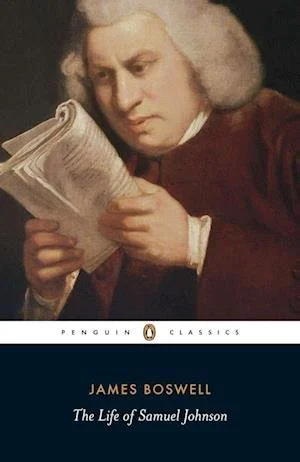
By James Boswell
Citation: Boswell, James. The Life of Samuel Johnson. With special contents by The George Macy Companies, Inc. New York: The Heritage Press, 1963. 3 Volumes.
Introduction:
The Life of Samuel Johnson speaks to the impact of living life-on-life, of a younger man wisely seeking the friendship, wisdom, and insight of one older; and the growth that occurs when one’s curiosity is high, mouth is shut, and ears are open.
About the author:
James Boswell (1740-1795), was of Scottish origin, but preferred life in London. His father, Alexander Boswell (Lord Auchinleck), was an advocate (a judge in the Scottish courts) and laird (large land owner). The younger Boswell was curious, adventurous, and promiscuous. He was also a brilliant diarist. His rare “faculty for imaginative verbal reconstruction” led Britannica to acknowledge Boswell as “one of the world’s greatest diarists.” Boswell met Samuel Johnson, when the famed biographer was 54 and Boswell just 22. Their friendship, which began rocky, ended rock-solid.
When raising the question, “Who is the ideal biographer?” Two-time Pulitzer Prize winning historian, Barbara Tuchman notes, “Boswell, I suppose is generally credited with the most perfect biography every written (or, rather, personal memoir, for it was not really a biography).” Coming from Tuchman, that’s high praise.
Edward G. Fletcher’s introduction to The Life Of Johnson gives testimony to the strength of the Johnson/Boswell friendship:
“They were friends, true and real friends, for the remaining twenty years of Johnson's life. During these years Boswell visited England fifteen times and was with Johnson for some part, at least, of about two hundred seventy-five days; besides this they were together for a little over three months when Johnson visited Scotland and the Hebrides in 1773. (Ix)
The book is not the vaulted highlights of one desiring to showcase his company among the great, though Boswell spent time in “rare air,” but a younger man captured by the brilliance of one older and giving due respect, usually forthright and at times obsequious.
Their deep friendship, breadth of conversation, frequent interactions, coupled with Boswell’s genius for the diary gives us one of the preeminent biographies of all time.
The book in a sentence (or two):
James Boswell provides the definitive account of the life of Samuel Johnson, the famed 18th century biographer, lexicographer, and essayist.
My quick take on The Life of Samuel Johnson:
Samuel Johnson captured my attention years ago when pondering one of his dictums, that "men more frequently require to be reminded than informed,” which came to me as “people need to be reminded more often than they need to be instructed.” This is a truism to which I return often. It is also the line that initiated this biographical pursuit.
My journey through the approximate 1200 pages was slow, but yielded rich rewards about reading, the history of the day (much occurred during the days of the American Revolution, insights into a life of prayer, the power of great minds in great conversations, and what a “life of the mind” well stewarded looks like. I have underlines, highlighted, and made notations throughout these three volumes.
About Samuel Johnson:
Samuel Jonson was a man of books, a biographer, lexicographer, and pious Christian. The Reverend Dr. Taylor, noted that piety was ever his primary object. 161 Boswell notes,
He reproved me once for saying grace without mention of the name of our LORD JESUS CHRIST, and hoped in the future I would be more mindful of the apostolical injunction. V1, 447; 1770.
He was a thinker who could be gruff in his mannerisms and sloven in his dress. About his disheveled appearance:
It must be confessed, that his apartment, and furniture, and morning dress, were sufficiently uncouth. His brown suit of clothes looked very rusty; he had on a little old shrivelled unpowered wig, which was too small for his head; his shirt neck and knees of his breeches were loose; his black worsted stockings ill drawn up; and he had a pair of unbuckled shoes by way of slippers. But all those slovenly particularities were forgotten the moment that he began to talk. V1, 281, 1763
About his occasional rough manner, the writer Goldsmith said,
Johnson, to be sure, has a roughness in his manner: but no man alive has a more tender heart. He has nothing of the bear but his skin. V1, 405; 1769
Johnson dearly loved his wife, Elizabeth “Tetty” Johnson, who was 21 years his senior when they married (he 25, she 46). She died at 63, and the loss impacted him greatly. This prayer on the anniversary of her death provides a snapshot of the man, his love for his wife, and desire to please God:
(After two years…four years…six years) Almighty God, sanctify unto me the reflections and resolutions of this day. Let not my sorrow be unprofitable; let not my resolutions be in vain. Grant that my grief may produce true repentance, so that I may live and please thee… Grant me that the loss of my wife may teach me the true use of the blessings which are yet left me, and that however bereft of worldly comforts, I may find peace and refuge in thy service… May my affliction be sanctified, and that remembering how much every day brings me nearer to the grave, I may every day purify my mind and amend my life, by the assistance of thy Holy Spirit, till at last I shall be accepted by Thee, for Jesus sake. Amen.
Johnson’s works are impressive. They include: multiple biographies and essays for The Gentleman’s Magazine; The Rambler (1750-1752), which was published twice a week and all but four articles written by Johnson; a Dictionary of the English Language (1875); book reviews, literary reviews, addresses, dedications, prefaces, books, and a host of letters.
Johnson’s Dictionary: A Dictionary of the English Language (1755). About this, Boswell notes, “The world contemplated with wonder so stupendous a work achieved by one man, while other countries had thought such undertaking fit only for whole academies.’ 203
Johnson self-assessment: Paul writes, “Do not think of yourself more highly than you ought, but rather with sober judgment” (Romans 12:3). This Johnson did. About himself, he wrote: “There are two things which I am confident I can do very well: one is an introduction to any literary work, stating what it is to contain, and how it should be executed in the most perfect manner; The other is a conclusion, shewing from various causes why the execution has not been equal to what the author promised to himself and to the public.” Johnson was good for more than this, but he sets a good example of sober thinking of one’s talents.
Johnson’s impact (on Boswell):
Johnson’s impact on others:
Johnson as seen by his contemporaries:”
Boswell’s veneration for Johnson is strong, but also insightful. He writes:
What pity it is, that so much wit and good sense as he continually exhibited in conversation, should perish unrecorded! Few persons quitted his company without perceiving themselves wiser and better than they were before. On serious subjects he flashed the most interesting conviction upon his auditors. . . . He seemed to me to be considered as a kind of public oracle, whom everybody thought they had a right to visit and consult; and doubtless they were well rewarded. V1, 441,443; 1770
He was known for being dour. Boswell writes that, “He used frequently to observe, that there was more to be endured than enjoyed, in the general condition of human life; and frequently quoted those lines of Dryden:
Strange cozenage! none would live past years again,
Yet all hope pleasure from what still remain. V1, 448; 1770
My Takeaways:
The author piqued my curiosity about these books:
On reading he said, “Let me know what English book you read for your entertainment. You can never be wise unless you love reading.” V1, 439; 1770 (to Mr. Francis Barber, at Mrs. Clapp’s, Bishop-Stortford, Hertforshire, London, September 25, 1770).
The Rambler, by Samuel Johnson
Johnson’s Piety and Prayers:
Johnson’s prayer for the New Year: Almighty God, who has continued my life to this day, grant that, by the assistance of thy Holy Spirit, I may improve the time which thou shalt grant me, to my eternal salvation. Make me to remember, to the thy glory, thy judgments and thy mercies. Make me so to consider the loss of my wife, whom thou hast taken from me, that it may dispose me, by thy grace, to lead the residue of my life in thy fear. Grant this, O LORD, for JESUS CHRIST’S sake. Amen.”
Johnson’s dependence on God to steward well his talents:
Oh God, who hast hitherto supported me, enable me to proceed in this labor, and in the whole task of my present state; that when I shall render up, at the last day, an account of the talent committed to me, I may receive pardon for the sake of Jesus Christ. Amen
1753; Vol 1, 173
Johnson’s Love for London:
The happiness of London is not to be conceived but by those who have been in it. I will venture to say, there is more learning and science within the circumference of ten miles form where we not sit, than in all the rest of the kingdom. V1, 411; 1769
No place, (he said) cured a man’s vanity or arrogance, so well as London; for as no man was either great or good per se, but as compared with others not so good or great, he was sure to find in a metropolis many his equals, and some his superiors. V1, 444; 1770; cf 454
Johnson On Reading:
In a letter to James Boswell, June 20, 1771, he writes:
I wished for your letter a long time, and when it came it amply recompensed the delay. I never was so much pleased as now with your account of yourself; and sincerely hope, that between public business, improving studies, and domestic pleasures, neither melancholy nor caprice will find any place for entrance. Whatever philosophy may determine of material nature, it is certainly true of intellectual nature, that it abhors a vacuum: our minds cannot be empty; and evil will break in upon them, if they are not preoccupied by good. My dear Sir, mind your studies, mind your business, make your lady happy, and be a good Christian. After this, “_____trisitiam et metus. Trades protervis in mare Creticum Portare ventis (translated: …sadness and fears. Hand them over to the wild winds to carry into the Cretan Sea). V1, 461; 1771
Words to ponder:
On writing and the judgments of the same (in reference to a book soon to be published): It must stand the censure of the great vulgar, and the small; of those that understand it and that understand it not. But in all this, I suffer, not alone; every writer has the same difficulties, and, perhaps, every writer talks of them more than he thinks. V1, 198 1755
Friendship: The greatest benefit which one friend can confer upon another, is to guard, and excite, and elevate, his virtues. Sam Johnson, Letter to Mr. James Elphinston, 1750 p. 142
On bringing our best: About Dr. Robert James upon the publication of his “Medical Dictionary” in 1743, “no man brings more mind to his profession.” 103
On John Milton: That poet, whose works may possibly be read when every other monument of British greatness shall be obliterated. 1751, p. 156
Friendly banter with his friend, Beauclerk: Everything thou dost shoes the one, and everything thou sayest the other period at another time he said to him, thy body is all vice, and thy mind all virtue. Beauclerk not seeming to relish the compliment, Johnson said “nay, Sir, Alexander the Great, marching in triumph into Babylon, could not have desired to have had more said to him. 168
Homelife: A man unconnected is at home every where; unless he may be said to be at home no where. 245
On his confidence in the Scriptures: I have established the truth of the Mosaical account, by evidence which no transcription can corrupt, no negligence can lose, and no interest can pervert. I have shewn that the universe bears witness to the inspiration of its historian, by the revolution of its orbs and the succession of its seasons; that the stars in their courses fight against incredulity, that the works of God give hourly confirmation to the law, the prophets, and the gospel, of which one day telleth another, and one night certifieth another; and the validity of the sacred writings never can be denied, while the moon shall increase and wane, and the sun shall know his going down. SJ, writing for the Reverend Dr. Kennedy, Rector of Bradley in Derbyshire, a Dedication to the King of Dr. Kennedy’s work, entitled “A complete system of Astronomical Chronology, unfolding the Scriptures.” 259
On turning down a request to provide a letter of recommendation: You ask me to solicit a great man, to whom I never spoke, for a young person whom I had never seen, upon a supposition which I had no means of knowing to be true.” 261
On his daughter-in-law (and keen observation): My daughter-in-law, from whom I expected most, and whom I met with sincere benevolence, has lost the beauty and gaiety of youth, without having gained much of the wisdom of age. V1, 263 1762
Johnson’s reply to The Earl of Bute who recommended SJ to King George for a pension: I shall endeavor to give your Lordship the only recompense which generosity desires, -- the gratification of finding that your benefits are not improperly bestowed. V1, 267 1762
On marriage (in a letter to Mr. Joseph Baretti, London, Dec 21, 1762): But love and marriage are different states. Those who are to suffer the evils together, and to suffer often for the sake of one another, soon lose that tenderness of look, and that benevolence of mind, which arose from the participation of unmingled pleasure and successive amusement. A woman, we are sure, will not be always fair; we are not sure she will always be virtuous: and man cannot retain through life that respect and assiduity by which he pleases for a day or for a month. I do not, however, pretend to have discovered that life has anything more to be desired than a prudent and virtuous marriage; therefore know not what counsel to give you.
On marriage: “A man has a very bad chance for happiness in that state, unless he marries a woman of very strong and fixed principles of religion.” V1, 411; 1769
On marrying again: But by taking a second wife he pays the highest compliment to the first, by shewing that she made him so happy as a married man, that he wished to be so a second time. V1, 412; 1769
On America: Johnson was an unabashed Anglophile. He and Boswell differed on this matter, but this line, like many, conveys his feelings about the upstart nation: To omit for a year, or for a day, the most efficacious method of advancing Christianity, in compliance with anmy purposes that teminate on this side of the grave, is a crime of which I know not that the world has yet had an example, except in the pratice of the planters of America, a race of mortals whom, I suppose, no other man wishes to resemble." V1, 377; 1766
On fear of death: In answer to Boswell’s question, “But is not the fear of death natural to man?” Johnson replied, “So much, so, Sir, that he whole of life is but keeping away the thoughts of it.” V1, 421; 1769 CF also pp. 432ff on his comments about David Hume and death.
Notes:
"men more frequently require to be reminded than informed” from, The Rambler (Issue No. 2, March 24, 1750)
When raising the question, “Who is the ideal biographer?” … from Tuchman, Barbara W. Practicing History: Selected Essays. New York: Alfred A. Knopf. 1981, p. 87.
