
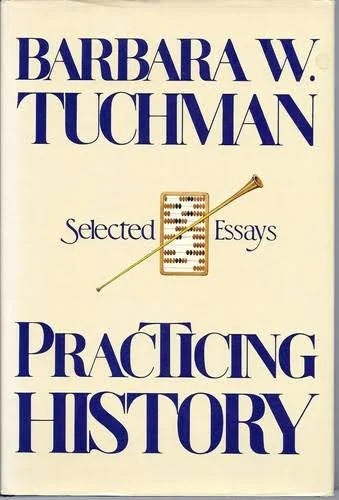
By Barbara Tuchman
Practicing History: Selected Essays by Barbara Tuchman
New York: Alfred A. Knopf. 1981
An Overview of Practicing History
Summary:
A preeminent historian gives a graduate-level course in writing, writing history, and by her example, the power of observation and the value of critique.
About the author:
American historian Barbara Tuchman (1912-1989) was a two-time Pulitzer Prize winning author for The Guns of August (1962), and Stilwell and the American Experience in China (1971). Tuchman saw herself as much a writer (of history) and as an historian than a biographer. “I do not think of myself as a biographer; biography is just a form I have used once or twice to encapsulate history.” (80). She said, “I think of myself as a storyteller, a narrator, who deals in true stories, not fiction.” (18) She was well read (see “The Historian’s Opportunity”), a student of the past as well as her times.
Practicing History in a sentence (or two):
Reflecting on a career spanning more than forty years (1934 to 1980), writer/historian Barbara Tuchman, two-time winner of the Pulitzer Prize, treats us to thirty-five of her works grouped under three headings: The Craft, The Yield, and The Lessons.
My take on Practicing History:
Practicing History is outstanding, and outstanding for me. As you will see in my gleaning below, there is much to learn from Tuchman about writing and about writing history (The Craft). The historical and political essays (The Yield), hold valuable lessons for her day and ours. In Part III (Learning From History), she asks: “Can we learn from the lessons of history?” Reading her work, the answer is, “Yes, but often we do not.”
Reading Tuchman’s observations of her days, reminds me that indeed, “there is nothing new under the sun.” Apparently, we don’t often learn from our past as well as we should, as we seem to be making the same mistakes today that we made then.
Overview and Analysis:
Practicing History is divided into three parts:
Part I: The Craft, exploring the art of writing and of writing history.
Part II: The Yield, in which the reader can taste the fruit of her skills in subjects ranging from America’s entrance into WW I, to President Woodrow Wilson, to Israel’s Six-Day War, to FDR’s 1936 campaign, to her assessment of Henry Kissinger (not flattering, see “Kissinger: Self-Portrait).
Part III, Learning from History. Here, Tuchman shares lessons we can learn from Vietnam, Watergate and more.
My analysis: Tuchman is a careful observer, a thorough researcher, and a brilliant writer. As noted above, Part 1 is a graduate course in writing and writing history. What a gift she has given in distilling a lifetime of lessons. The remaining portion of the book showcase astute observations, unflattering commentary, and a delightful sense of humor.
My Takeaways:
My reviews are that, reviewing an author’s work to provide an overview for a prospective reader, but they serve a dual purpose in that I share my personal gleanings — for my sake and for those who might appreciate some of the Aha! Moments. In this book there are many, so buckle up . . . skim through what you find below for areas that interest you.
On Writing History:
Defining history: “I am content to define history as the past events of which we have knowledge and refrain from worry about those of which we have none—until, that is, some archeologist digs them up.” 27 To write that history, Tuchman says, “the historian needs distance” from his or her subject. “Love and reverence are not the proper mood for a historian.” 88
Chronological narrative rules! “Material must precede the thesis, that chronological narrative is the spine and the blood stream that brings history closer to ‘how it really was” and to a proper understanding of cause and effect; that, whatever the subject, it must be written in terms of what was known and believed at the time, not from the perspective of hindsight.” 9 Would Tuchman take issue with The 1619 Project and many other current historical works? “Chronology remains the spine.” (70)
Will the reader turn the page? To write history so as to enthrall the reader and make the subject as captivating and exciting to him as it is to me has been my goal since that initial failure with my thesis. A prerequisite, as I have said, is to be enthralled oneself and to feel a compulsion to communicate the magic. Communicate to whom? We arrive now at the reader, a person whom I keep constantly in mind. Catherine drinker Bowen has said that she writes her books with a sign pinned up over her desk asking, “Will the reader turn the page?” 16 In “Biography as a Prism of History” she adds, “Whether in biography or straight history, the writer’s object is—or should e—to hold the readers’ attention.” 89
Beware of beguilement: “The historian is continually being beguiled down fascinating byways and sidetracks. But the art of writing – the test of the artist – is to resist the beguilement and cleave to the subject.” 18
The artistry of writing history: The historians task is to find out what really happened, or, literally, how it really was; which will always remain just out of one’s grasp for the reason the historian was not there.” We can never be certain that we have recaptured it as it really was. But the least we can do is to stay within the evidence.” 18 Tuchman only uses primary sources (cf p. 42). If describes as scene so vividly that one might think she is utilizing artistic embellishment, she is not. She has even tracked down weather reports to lend credence to a passage.
The most important thing about research: Knowing when to stop! “One must stop before one has finished; otherwise, one will never stop and never finish.” 20
Two types of historians: Onlookers chronicle an event of their own age (war, strike, social upheaval). Theodore White’s The Making of a President. Active Participants or Axe-Grinders attempt a genuine history, but their accounts suffer from the desire the writer has to be placed and how placed in them. Churchill’s World Crisis and Second World War are examples. 27-28
A disciple of the ounce: Tuchman said, “I am a disciple of the ounce because I mistrust history in gallon jugs whose purveyors are more concerned with establishing the meaning and purpose of history than with what happened.” 35
The importance of corroborative detail: It is the great corrective. Without it historical narrative and interpretation, both, may slip easily int the invalid. …However persuaded the historian may be of the validity of the theories he conceives, if they are not supported and illustrated by corroborative detail they are of no value. 34
The value of novels to writing history: Well written novels help one see the times. Cf 40-41
The three half’s of history: “The desire to find the significant detail plus the readiness to open his mind to it and let it report to him are half the historian's equipment. The other half, concerned with the idea, point of view, the reason for writing, the “Why” of history, has been left out of this discussion although I am not unconscious that it looms in the background. The art of writing is the third half. If that list does not add up, it is because history is human behavior, not arithmetic.” 44
Two criteria of good writing: Be clear and interesting. 46
The best historian: “Trevelyan Wrote that the best historian was he who combined knowledge of the evidence with ‘the largest intellect, the warmest human sympathy and the highest imaginative powers.’ The last two qualities are no different than those necessary to a great novelist.”
The historian’s advantage: Historians start with a great advantage over fiction in that art characters, being public, are invested with power to affect destiny. They are the captains and kings, saints and fanatics, traders, rogues and villains, pathfinders and explorers, thinkers and creators, even, occasionally, heroes. They are significant—if not necessarily admirable. They may be evil or corrupt or sad or stupid or even stuffed shirts, but at last, by virtue of circumstance or chance or office or character, they matter. They are the actors, not the acted upon, and are consequently that much more interesting. 54
The historian’s most compelling instrument: Belief in the grandeur of his theme. 59
The importance of place: As Robert Caro moved to the hill country of Texas in order to write the life of Johnson, so Tuchman traveled to Hongkong and Taiwan “to get a feeling of Chineseness” and to conduct interviews for writing the biography of Stilwell. 69
On bias: “As John Gunther once said of journalism, “a reporter with no bias at all would be a vegetable.” if such a thing as a “purely objective” historian could exist, his work would be unreadable—like eating sawdust. Bias is only misleading when it is concealed.” 59
The necessity of passionate commitment to one’s subject: “The great historians more often than not have been passionately committed to a cause or a protagonist, as Mommsen was to Julius Caesar or Michelet to the glorious power of the people.” TK: I think of Robert Caro to Lyndon Johnson. 60
Distillation: “Distillation is selection, and selection, is the essence of writing history. What it requires is simply the courage and self-confidence to make choices and, above all, to leave things out. . . . In history as in painting, wrote the great stylist Macaulay, to put in everything achieves a less, rather than a more, truthful result. The best picture and the best history, he said, are those “which exhibit such parts of the truth as most nearly produce the effect of the whole period” this is such an obvious rule that it is puzzling why so many historians today seem to practice a reverse trend toward total inclusion.” p. 62
On the importance of empathy: Herder demanded Einfuhlung of historians: the effect to ‘feel oneself into everything. “The interpreter of the Hebrew scriptures, as he put it, must be ‘a shepherd with shepherds, a peasant in the midst of an agricultural people, an oriental with the primitive dwellers of the East.’” 63
Introducing people and places: “I try never to introduce a place name without locating it in relation to some place already mentioned, nor introducing a person without describing some attribute that will fix him in the reader’s mind. People and places must be given recognizable identities, otherwise the reader flounders in a sea of unknowns; he will miss the point of this or that and sooner or later, bored by incomprehension, will drift away.” 71
Do not argue the evidence in front of the reader: “The author’s thought processes have not place in the narrative. One should resolve one’s doubts, examine conflicting evidence, and determine motives behind the scenes, and carry on any disputes with one’s sources in the reference notes, not in the text. For one thing, this keeps the author invisible and the less his presence is felt, the greater the reader’s sense of immediacy to the events. Additionally, you free the reader from “maybes and perhaps.” 75
On the importance of “roaming the stacks”: “To roam the stacks is of course the most delightful, if not the most discipline, form of research, and the most productive of discoveries. Colleged before you is all the gather wealth on your subject. You can examine, compare, explore, and choose.” 78 What would Tuchman say in today’s world of internet and AI?
On “intuitive flashes” (and Freud): Giving free rein to intuitive flashes may be fun, but it is not history and it is not science. These disciplines require that the intuitive flash must stand the test of evidence. About “intuitive flashes” and Sigmund Freud, about whom she was not bewitched (see her comments p. 157), she writes, “Freud, by reason of the change he wrought on habits of thought, with effect on art, literature, philosophy, medicine, social relations, and indeed almost any aspect of modern life, is one of the world's outstanding figures, but when he called his method “the science of the unconscious” he was setting a standard that it does not live up to.” 155
Beware of oversimplification: Her comment on Woodrow Wilson’s biographer’s, whom she felt were too narrow, are good caution for historians and writers: “They are addicted to the oversimplified single explanation of great events.” (page 157)
Just the facts! “A historian cannot pick and choose his facts; he must deal with all the evidence.” 253
You need 25 years: “A historian needs, I think, a perspective of at least twenty-five years, and preferably fifty, to form an opinion of any value.” 273
On Writing & Communication:
Use language well: In referencing enthusiasm for one’s subject: “Enthusiasm had not been enough; one must also know how to use the language.” 16
Use short words: “In my opinion, short words are always preferable to long ones; the fewer syllables the better, and monosyllable, beautiful and pure like ‘bread’ and ‘sun” and ‘grass,’ are best of all. 17
Writing is more difficult than research: “Research is endlessly seductive writing is hard work. One has to sit down on that chair and think and transform thought into readable, conservative, interesting sentences that both make sense and make the reader turn the page. Its laborious, slow, often painful, sometimes agony. It means rearrangement, revision, adding, cutting, rewriting. But it brings a sense of excitement, almost of rapture; A moment on Olympus. In short, it is an act of creation.” 21
In discussing her challenges of researching General Stilwell for his biography (pp 66-75), she writes: “I would rather talk about the problems of writing, not only because they interest me more but because the average layman underestimates writing and is overimpressed by research. People are always saying to me in awed tones, ‘Think of all the research you must have done!’ as if this were the hard part. It is not; writing, being a creative process, is much harder and takes twice as long.” 69, “Problems in Writing the Biography of General Stilwell”The power of words: Watch out for carelessly used words. “They have almost frightening autonomous power to produce in the minds of the reader an image or idea that was not in the mind of the writer.” . . . For me . . . the art of writing interests me as much as the art of history (and I hope it is not provocative to say that I think of history as an art, not a science). In writing I am seduced by the sound of words and by the interaction of their sound and sense.” 38
Kill your darlings: Writers must be willing to “kill” beautifully crafted sentences if they don’t fit history or the point being made. 39 In discussing the problems of writing the biography of General Stilwell, Tuchman emphasized the importance of letting go of a prized lined because it did not fit, “it no longer belonged.” 73
Writing a good sentence: “When it comes to language, nothing is more satisfying than to write a good sentence. It is no fun to write lumpishly, dully, in prose the reader must plod through like wet sand. But it is a pleasure to achieve, if one can, a clear running prose that is simple yet full of surprises. This does not just happen. It requires skill, hard work, a good ear, and continued practice, as much as it takes Heifetz to play the violin.
The necessity of the command of language: “Vision, knowledge, experience will not make a great writer without that extra command of language which becomes their voice. This, too, was Parkman’s. When the English are about to descend the rapids of the upper St. Lawrence, they look on the river whose ‘reckless surges dashed and bounded in the sun, beautiful and terrible as young tigers at play. In choice of verbs and nouns and images that is a masterpiece. It is only physical description, to be sure, not a great thought, but it takes perfect command of words to express great thoughts in the event one has them. 61-62
Trouble in writing: “As a writer I can tell you that trouble in writing clearly invariable reflects troubled thinking, usually an incomplete grasp of the facts or of their meaning.” 284
On Leaders and Leadership:
On the subject of leadership, gleanings from “Israel’s Swift Sword”: This is a “re-read chapter” for me. It stood out for leadership insights gleaned from the way Israel prepared to defend itself upon becoming a nation in 1948. Among lessons gleaned:
All-In Mindset: The absolute fulfillment of mission by all ranks under all circumstances and the fullest exploitation of every resource, particularly knowledge of the enemy and weapon capacity.” 174
Continual Preparation: “the manpower of the nation (up to the age of 49) was kept prepared through constant and rigorous exercise ….” Reservest were kept in a state of readiness through annual training for periods of 4-6 weeks. 174-5
Officers must be self-critical and obstinate (about sticking to his mission until it is carried out). Three essentials for an officer: A spirit of inquiry, execution of mission, and orientation—to the terrain and the task. “And of course leadership and audacity, that is understood.” An officer is one who leads, and to lead, he has to be ahead, ‘ahead too of what occurs.” 177 #LBC
Leaders, don’t ignore the wisdom of those “on the ground.” In her essay, “If Mao Had Come to Washington,” Tuchman shares how hubris on the part of the Patrick Hurley, American Ambassador to Chinese, led him to ignore the observations and insights of those who spoke the language and who collectively had decades of Chinese experience. Reading Tuchman’s assessment of US-China policy and relations in 1945, sounds eerily similar to today under President Trump. As to Hurley’s dismissal of the advice of his aids, her comments are worth repeating:
[Hurley] could not admit, and perhaps never understood, that his own estimate of the situation had been inadequate and the current of Chinese affairs simply too strong for him. Beyond Hurley, responsibility lay with the President. . . . Hindsight makes his rejection of the embassy's advice appear shortsighted, but every historical act is entitled to be examined in light of the circumstances that surround it.
... No one within the government who could effectively counter Hurley's version, had regular access to Roosevelt. This left a terrible gap.
Here's a beam of life on the most puzzling aspect of our China policy: why the information and opinions provided by experienced observers maintained in the field for the express purpose of keeping our government informed were so consistently and regularly ignored.” To Tuchman, the answer “lies in the deep-seated American distrust that still prevailed of diplomacy and diplomats, the sentiment that disallowed knee breaches for Americans.” 202-204On women in leadership: Commenting on Freud and Vietnam, she notes “The instinct says, ‘I shall conquer, I shall live.’ It is also a male instinct. Women, being child-bears, have a primary instinct to preserve life. Probably if we had a woman in the White House and the majority of females in Congress, we could be out of the Vietnam War yesterday. 264
From the Tuchman Essay, “Generalship”
Character & Competency: The qualities it requires divide themselves into two categories as I see it: those of character, that is personal leadership, and those of professional capacity. When it comes to command in the field, the first category is probably more important than the second, although it is useless, of course, if separated from the second, and vice versa.” 277
Will: it is the determination to win through, whether in the worst circumstances merely to survive or in a limited situation to complete the mission, but, whatever the circumstances, to prevail. It is this will to prevail, I think, that is the Sena quinnan of military action. If a man has it, he will also have, or he will summon from, the courage to support it. But he could be brave as a lion and still fail if he lacks the necessary will. CF Stilwell, page 278
Perspective: Leaders need to be inside and outside an event at the same time: She notes CP Snow’s comment that judgment [is] “the ability to think of many matters at once, in their interdependence, their related importance, and their consequences.” CP Snow 278 Tuchman later adds: “One needs to step outside a phenomenon in order to see its shape, and one needs perspective to be able to look back and say, “There was the turning point.” 282
Unflappable: About general Joffre: he possessed an unsurpassed degree of quality of great importance for generals: he was unflappable. Steadiness of temperament in a general is an asset at any time, and the crown of steadiness is the calm that can be maintained amid disaster. 279
The best leaders instill confidence: As important as tactics and terrain: the quality of command rests not only on the general's knowledge of tactics and terrain and resources and enemy deployment in a specific situation, but on the degree of faith that his subordinates have in his knowledge. “When Stilwell told you what to do in Burma,” said an officer, “you had confidence that was the right thing to do. This is what a soldier wants to know.” 279
Lafayette on George Washington: “Never have I seen so superb a man.”
thoughts That resonated:
On perseverance: Good things take time and tenacity. Tuchman started work on Bible and Sword in 1948, “which took six or seven years of very interrupted effort and quite a while longer to find a publisher.” 7
On libraries: The single most formative experience in my career took place. It was not a tutor or a teacher or a fellow student or a great book or the shining example of some famous visiting lecturer... It was the stacks at Widener. They were my Archimedes bathtub, my burning bush, my dish of mold where I found my personal penicillin. I was allowed to have as my own one of those little cubicles with a table under a window, queerly called, as I have since learned, carrels, a word I never knew when I sat in one. . . . I could roam at liberty through the rich stacks, taking whatever I wanted. The experience was marvelous, a word I use in its exact sense meaning full of marvels. The happiest days of my intellectual life, until I began writing history again some 15 years later, were spent in the stacks at Widener. 15 #LRR See above: “Roaming the stacks”
On the value of biography: It encompasses the universal in the particular. It enable the writer to narrow his field to a manageable subject, and enables the reader to more easily comprehend the subject. 81
On Narcissism and now-ism: Writing in 1981, she said: “Narcissism and now-ism—the self and the present—are the two governing concerns of the campus at the moment.”
On Sigmund Freud: See her summary comments on p. 157
On “How We Entered World War I”: I gleaned more from this portion of Part II, Yield, than of any other essay in that section.
Our current distress: We have suffered the loss of two fundamental beliefs—in God and in progress; two major disillusionments—in so socialism and nationalism; one painful revelation—the Freudian uncovering of the subconscious; in one unhappy discovery—that the fairy godmother Science turns out to have brought as much harm as good. 268
The timeliness of some of her essays to today:
“How We Entered World War I” – Her discussion of acquisitive and preventative war. We have moved from self-defense to policing world affairs, from “the illusion of isolation with a new illusion of omnipotence.” “Where once we saw ourselves self-contained and free to stand apart, we now see ourselves as if endowed with some mission to organize the world in our image. . . . We cannot mold the non-Western world to our desires. . . . The better part of valor is to spend [time] learning to live with difference, however hostile, unless and until we an find another planet.” 170-172Governmental distrust (there’s nothing new under the sun - US/Vietnam, US/Iran relations): In a 1979 review of Kissinger’s White House Years for the New York Times, Tuchman made this comment about Kissinger’s assertion of the credibility gap between government and it’s citizens: “but he never traces any connection between the public's lack of trust and the acts and policies of the administration he represented. He has no inkling of the concomitant damage: that the cost of playing tough may come too high; that a foreign policy that alienates one's countrymen and causes dislike and distrust of government is not worth what it might gain against the adversary; that a nation's strength lies ultimately in its self-esteem and confidence in what is right; In that whatever damages these damages the nation.” 226
On art: The greatest recourse, and mankind's most enduring achievement, is art. At its best, it reveals the nobility that coexists in human nature along with flaws and evils, and the beauty and truth it can perceive.... The prose and poetry of all the writers from Homer to Cervantes to Jane Austen and John Keats to Dostoevsky and Chekhov—who made all these things? We—our species—did . 236-7 Genesis 1:1 “God created,” 1:26, “Let us make man in our image.”
The author piqued my curiosity about these books:
The Lyndon Johnson Story, as one intrigued by the enigma that was Lyndon Johson, and who gathers every book he can, Tuchman warned me off this one. At the least, recognizing that it was hastily pieced together.
Plutarch (the father of biography), Parallel Lives
The Proud Tower by Tuchman
Words to ponder:
Freedom: “Those who expect to reap the blessing of freedom, must undergo like men the fatigue of supporting it.” Tom Paine 299
Objectivity: “Objectivity is a question of degree. It is possible for the latter-day historian to be at least relatively objective, which is not the same thing as being neutral or taking sides. There is no such thing as a neutral or purely objective historian. Without an opinion a historian would be simply a ticking clock, and unreadable besides.” 29
What Tuchman taught me about studying LBJ: I have the beginnings of my outline on my LBJ project. These words help me as I wrestle with my subject: The more necessary use of imagination is in application to human behavior and to the action of circumstance on motive. It becomes a deliberate effort at empathy, essential if one is to understand and interpret the actions of historical figures. With antipathetic characters it is all the more necessary. The historian must put himself inside them, as Parkman put himself inside the wild goose, whereas I tried to do inside John French in an effort to understand the draining away of his will to fight. 63
In “Biography as a Prism of History,” these lines resonated with me: Speaking of Czar Reed, “He was so obviously ‘writable’ – if I may invest a word, which is against my principles . . . . I now felt he was my personal property and became seized with fear that someone else would surely see his possibilities and publish something in the years before my book . . .” I have felt the same about my LBJ and Plimsoll projects. 83
In “If Mao Ha Come to Washington,” she noted the importance of examining every historical act in light of the circumstances that surround it. This is to me, why LBJ is worth studying and learning from. 203
See also, “Why Poliy-Makers Do Not Listen” 290 et alThe power of the poets: The poets have familiarized ore people with history than have the historians, and sometimes they have given history a push. Example: Kipling’s “Recessional” which Oscar Wilde pronounced “the greatest poem written by any living man. 31
Lo, all our pomp of yesterday
Is one with Nineveh and Tyre!
Judge of the Nations, spare us yet,
Lest we forget—lest we forget!
On power: “Power is an aphrodisiac.” Henry Kissinger 221
About Teddy Roosevelt: The president, said his great friend ambassador Jean Jules Jusserand of France, “is in his best mood. He is always in his best mood.” #Forging
About foreign policy: Basic to the conduct of foreign policy is the problem basic to all policy: how to apply wisdom to government. If wisdom in government eludes us, perhaps courage could substitute—the moral courage to terminate mistakes. 207 cf 284 (Trump/Iran); “Watergate and the Presidency” (Is she addressing then or now?!). In “Watergate and the Presidency” she writes, “If there was one lesson to be learned from Watergate, it was the danger in overuse of the executive branch and in interference with the judicial system.” 302 Whoa! Sounds like today! Her fear, lost virility in our country about which she said, “If lost virginity cannot be restored, neither can lost virility.” 302
On war: “It is not the nature of the military man that accounts for war, but the nature of man.” 264
On divisions within our country: “Nor should we be paralyzed by fear of exacerbating divisions within this country. We are divided anyway and always have been, as any independently minded people should be. . . . A nation in consensus is a nation ready for the grave.” 301
On immigration (Newsweek, July 12, 1976) in “On Our Birthday — America as Idea: “Every wave of immigration brought here those people who had the extra energy, gumption, or restlessness to uproot themselves and cross an unknown ocean to seek a better life.” 305
Areas I need to go deeper:
A picture of VISION: The Dutch dike enclosing the Zuiderzee. Read “Mankinds Better Moments” 227-230.
Perseverance: La Salle’s search for the mouth of the Mississippi. 232-233
Chapters I must re-read:
“Israel’s Swift Sword” - For historical context and leadership lessons.
“Mankind’s Better Moments” - To be reminded of the grand and good.
“Generalship” - For leadership lessons.
“Vietnam” - For background on my Enigma project.
Conclusion:
How to end this lengthy review. I return to two of Tuchman’s essays. In “Mankind’s Better Moments,” she asks, “Is there anything to learn from my survey [of humankind’ vast achievements}? I raised the question only because most people want history to teach them lessons, which I believe it can do.” However, as Tuchman notes, “I'm less sure we can use them when needed.”
Later, in “Is History a Guide to the Future?,” she continues this theme when she writes, “There are lessons, of course... One is to enable us to avoid past mistakes and to manage better in similar circumstances next time; the other is to enable us to anticipate a future course of events. To manage better next time is within our means; to anticipate does not seem to be. 249
Such words may leave us discouraged, but that is not her intention. Tuchman “gathered these examples not to teach but merely to remind people in a despondent era that the good in mankind operates even if the bad secures more attention.” 242
We learn from the past, but it is God who gives us hope for the future!
