
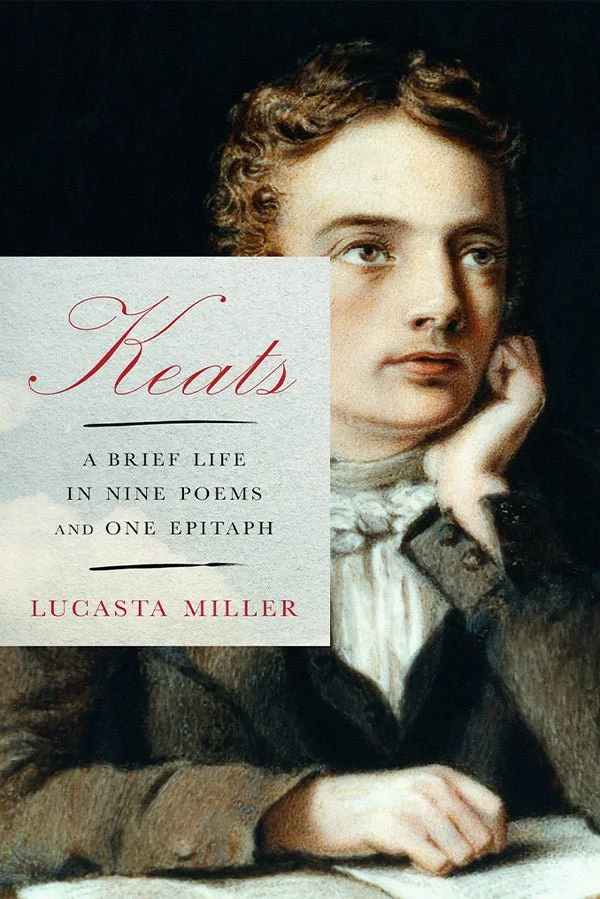
by Lucasta Miller
I am the furthest thing from a poetic critic, but my knowledge of Keats, his life and work, has grown exponentially thanks to Lucasta Miller’s fine work.
Overview
The author takes nine of Keat’s best-known poems and “excavates their backstories, looking behind their popularity as anthology pieces to the context of their creation.” 3 She examines:
“On First Looking into Chapman’s Homer”
“A thing of beauty is a joy for ever” (from Endymion)
Isabella; or The Pot of Basil
“The Eve of St. Agnes”
“La Belle Dame sans Merci. A Ballad”
“Ode to a Nightingale”
“Ode on a Grecian Urn”
“To Autumn”
“Bright Star”
This journey is made more enjoyable in that Lucasta Miller grew up in Keats neighborhood and lives only a stones throw from Wentworth Place, where Keats lived for a time and which is now the Keats House museum.
Keats Influence
Keats had a melancholy upbringing. He was orphaned early, losing a mother and brother to Tuberculosis. His early years were unspectacular, though he is recognized for his ability — even at a young age — to spin words. According to Miller, Keats denied the divinity of Christ, but recognized Jesus and Socrates as “uniquely inspired” human beings. He dipped into Greek and Roman mythology as “allegories or metaphors for the human condition.” He was not born poor, but never was rich. Many days, after giving up medicine for poetry, he struggled financially. Near the end of his life he was smitten by the young Fanny Brawne; she consuming his thoughts and the subject of his words.
BRILLIANT POETRY
Keats delivered memorable lines, some of which have passed into use without the users probably knowing the source. Such are these lines from Keats’ Endymion:
A thing of beauty is a joy forever:
Its loveliness increases; it will never
Pass into nothingness; but still will keep
A bower quiet for us, and a sleep
Full of sweet dreams, and health, and quiet breathing.
But, for the general award of love,
The little sweet doth kill much bitterness.”
Negative Capability
In a letter written to his brothers in December 1817, Keats notes, “several things dovetailed in my mind & at once it struck me, what quality went to form a Man of Achievement especially in Literature & which Shakespeare possessed [six] so enormously—I mean negative Capability, that is when a man is capable of being in uncertainties, Mysteries, doubts, without any irritable reaching after fact & reason.” 193
Lessons from the life of Keats
inspiration Must be matched by perspiration
One might look at a John Keats, whose words dance across the page with the grace of a ballet dancer, as that of gifted “poetic inspiration.” Keats helped to promote such a thought. In a letter to his publisher, John Taylor (February 27, 1818 ), he wrote, “If Poetry comes not as naturally as the Leaves to a tree it had better not come at all.” I appreciate Miller's commentary on this line of Keats, for it sheds light on the poet and is a reminder to the rest of us that inspiration often walks hand-in-hand with perspiration.
What Keats meant, perhaps, was that the best lines were those that came to the mind unimpeded. By 1819, Keats was able to draft something as formerly, imagistically and emotionally complex as “Ode to a Nightingale” in a couple of hours. The evidence shows that such free flow did not drop miraculously from heaven but came as the latter upshot of prior, intensive application, fueled by reading. 27
While I am not a proponent of “luck,” Lucasta Miller’s comments reminds me of the line erroneously attributed to Thomas Jefferson, “I’m a great believer in luck. The harder I work, the more luck I have.” Yes, some have greater gifts than others, but with the 16th century proverb we can say, “Diligence is the mother of good luck.” Keats was diligent, an avid reader of ….. And one must remember that Keats, before he embarked on a serious life of poetry, was a seriously hard-working medical student, “studying medicine and working long hours as a junior doctor.” 28
Don’t get stuck
I spent decades as a pastor. On many occasions I was stuck and stumped during my sermon preparation. Year ago, John Ortberg offered this advice, “Don't get stuck.” Thanks a lot! Actually, this helped me a lot. Ortberg’s point being, you can’t wait for holy perfection in preparation; the preparation itself is how God forms the message and the messenger. You can’t wait till you have the words, “just right,” move on! I thought of that advice as I reflected on how Keats sought to circumvent, or perhaps better said, “plow through his periods of emotional “lassitude and despair”.
Throughout his brief existence, periods of energy annihilation would counterpoint with phases of lassitude and despair, though he tried practical ways of countering depression. “Whenever I find myself growing vapourish, he wrote on September 17 1819, “I rouse myself, wash and put on a clean shirt brush my hair and clothes, tie my shoe strings neatly and in fact adonize as I were going out—then all clean and comfortable I sit down to write. This I find the greatest relief.” 39
But poetry was bigger
When does one give up one dream to pursue another? This is a very important question. Lucasta Miller's observation about how Keats navigated this crossroads in his life provides help in answering that question.
Keats was a budding physician in 1816. He had passed his apothecaries exam, had been promoted to the role of “dresser,” akin to a junior doctor today and elevating him to a place of assisting experienced surgeons and performing certain surgical procedures himself. Physicians of that day did not garner the same honor as a ??, but the work was respectable and would lead to a comfortable life. Miller comments:
Giving up a career in which he was already proving himself was no small thing. But poetry was bigger.
Every person standing at the decisional crossroads of a major life shift must ask himself/herself, “What’s the ‘bigger?”, the bigger joy, the bigger pull, the bigger fulfillment, the bigger investment? Keats life was the embodiment of the Robert Frost poem, for he took the road less traveled and it made all the difference.
Self-Confidence, Tenacity, and Friends who believed in him
Keats took a critical beating after publishing Endymion. Both the Quarterly Review in London and Blackwood’s Edinburgh Magazine printed blistering critiques; the Quarterly a touch more kind, but still harsh. So why did he continue? As I read Lucasta Miller, I see three elements to Keats stick-to-itiveness:
Keats had a strong sense of self-confidence. Miller writes, “It was in the context of the assaults of Blackwood’s and the Quarterly that Keats confidently told his brother that he thought he would be ‘among the English Poets’ after his death. He was right. In the context of his oeuvre, Endymion was a failed experiment, but it has indeed outlives him, its first line taking on a life of its own as it has replicated through culture. . . . Keats was proved right. His work is now indeed in the canon alongside that of Shakespeare and Milton.” 78
Keats was tenacious. John Keats had his ups and downs and enjoyed only a very short life, but he refused to quit.
Keats had benefactors. John Taylor was the editorial director for the publisher, Taylor and Hessey. He “showed a commitment and concern” for Keats that looked “beyond the short term.” Taylor’s friend and literary-minded lawyer, Richard Woodhouse, also was in his corner. Miller notes that “Both men firmly believed in Keats’s genius, and that his poetry would last.” 70 They proved their belief and loyalty until the poet’s untimely death. Miller notes, “Without John Taylor’s patience, belief and liberality, Keats would nto have published Endymion or his 1820 collection. Posterity has a reason to be glad.” 123
Looking back on the life of Keats has me questioning myself: “Do you have the critical discernment of and confidence in your own gifts and abilities to pursue your passion?” What is more, do you have the tenacity to purse your quest even in the face of critical detractors?
You must take time to refuel
In 1993, the Red Hot Chili Peppers won a Grammy for their song, “Give It Away.” I called Anthony Kiedis, my nephew, to congratulate him. I asked him, “So what’s next, you going to write?” “No, I’m going to take some time to live. My best songs come out of life.” Anthony had been touring and working relentlessly. He needed time to live, to put some “daily” back into his days.
Keats faced a similar challenge. 1819 was his most productive year. During that time he wrote
"The Eve of St. Agnes”
“The Eve of St. Mark”
“Gif ye wol stonden hardie wight”
“Why did I laugh tonight?”
“Faery Bird’s Song”
“Faery Song”
“When they were come unto the Faery’s court”
“The House of Mourning written by Mr. Scott”
“Character of Charles Brown”
“A Dream, after reading Dante’s episode of Paolo and Francesca”
“La Belle Dame sans Merci. A Ballad”
“Song of Four Faeries”
“To SleeP
“If by dull rhymes our English must be chained”
“Ode to Psyche”
“On Fame (I)”
“On Fame (II)”
“Two ore three Posies”
“Ode to a Nightingale”
“Ode on a Grecian Urn”
“Ode on Melancholy”
“Ode on Indolence”
Otho the Great: A Tragedy in Five Acts
Lamina
“Pensive they sit, and roll their languid eyes”
“To Autumn”
“The Fall of Hyperion. A Dream”
“The day is gone, and all its sweets are gone!”
“What can I do to drive away”
“I cry your mercy, pity, love—ay, love!”
“Bright star! would I were steadfast as thou art”
“King Stephen. A Fragment of a Tragedy”
“The living hand, now warm and capable”
“The Cap and the Bells; or, The Jealousies”
Look at that body of work. Keats was expending tremendous amounts of creative energy. Should we be surprised that Keats “told a correspondent in Devon, Sarah Jeffrey, ‘I've been very idle lately, very adverse to writing.’ And yet he was halfway through his most productive year and had recently completed four of his five great oaths.” 207 There’s a lesson here on the importance of taking time to recoup and not to beat oneself for feelings of lethargy in the midst of a very hectic season.
Hey, New Leader!
Keats teaches any new leader to pay attention to his/her daily tasks and to be wise to recognize the proficient and profitable season (1819 for Keats). Be present in both, maximize the latter.
On April 30, 1819, another new poem appears in his letter to George and Georgiana; “Ode to Psyche.” It was a harbinger of the so-called Great Odes, which, since the mid-nineteenth century, have generally been regarded as the apex of his achievement.... Keats did not know it, but he was about to write the most significant poetry of his life. 194
Effective leadership is daily discipline, seasons of intense activity, and times for rest and renewal.
Odds and Ends
A film to watch: Bright Star (2009), which highlights the poet’s relationship to Fanny Brawne, with whom he fell in love near the end of his life.
Notable biographies: John Keats by Amy Lowell (1924), John Keats by Robert Gittings (1968) and Nicholas Roe’s monumental John Keats: A New Life (2012).
Conclusion
Keats genius and mastery was not recognized in his lifetime. He did not let that deter him from pursing his best; a good lesson for all.
